
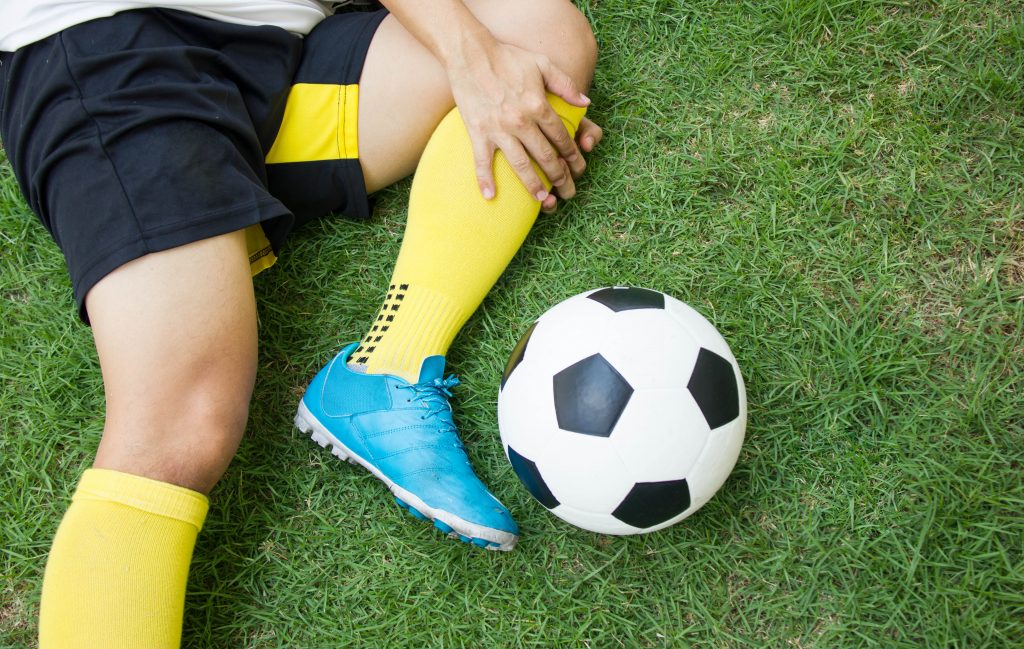
Football is one of the most popular sports in the world. The sport has many benefits to one’s lifestyle such as the improvement of one’s cardiovascular health, increase in coordination and enhancement of strength and flexibility. With the rise of players worldwide, there is no doubt that the rate of injury is also increasing. Players must be aware of the risks of these injuries to prevent it, detect it at an early stage and know how to treat it.
WHAT ARE SOME COMMON FOOTBALL INJURIES?
Lower Extremity Injuries
The most common lower extremity injuries experienced by football players are strains and sprains. Some injuries that require surgery are cartilage tears and Anterior Cruciate Ligament (ACL). Since football is a physical contact sport, injuries may occur from contusions and direct blows to the body.
Overuse Lower Extremity Injuries
Patellar Tendinitis (pain in the knee), Shin Splints (soreness in the calf), and Achilles Tendinitis (pain in the back of the ankle) commonly arise from stress fractures. This mainly happens when the bones become overused and later on becoming too weak.
Upper Extremity Injuries
Injuries to the upper extremities usually occur from falling on an outstretched arm or from player-to-player contact. These conditions include wrist pains, wrist fractures and shoulder dislocations.
Head, Neck and Face Injuries
Injuries to the head, neck and face include cuts and bruises, fractures, neck sprains, and concussions. A concussion is an alteration in an athlete’s mental state due to head trauma and must be evaluated by a physician.
HOW ARE FOOTBALL INJURIES TREATED?
Participation should be stopped immediately until any injury is evaluated and treated properly. Most injuries can be minor and require a short period of time to heal. If a trained health care professional such as an attending physician or athletic trainer is available to treat the injury instantly, an athlete can be allowed to continue playing. Overuse injuries can be treated with a short period of rest, which means that the athlete can continue to perform activities with some modifications. An athlete should only return to play when clearance is granted by a health care professional.
HOW CAN FOOTBALL INJURIES BE PREVENTED?
- Have a pre-season physical examination and follow your doctor’s recommendation
- Use well-fitting cleats and shin guards
- Be aware of poor field conditions that can increase injury rates
- After a period of inactivity, progress gradually back to full-contact football through activities such as aerobic conditioning. Strength training, and agility training
- Speak with a sports medicine professional or athletic trainer if you have any concerns about injuries or prevention strategies
 Aspire Football Academy